
Therapy Effectiveness Statistics: Does Therapy Really Work?

Yes, therapy works. People who attend therapy are about twice as likely to feel much better as people who go without it, and decades of research back this up. This page brings together the most trusted therapy effectiveness statistics and explains each one in plain language, so you can decide whether therapy is the right step for you.

Key Therapy Effectiveness Statistics:
42% of adults with depression improve a lot in therapy, compared with 19% without it.
People in therapy are 2 to 9 times more likely to cut their symptoms in half.
53% of people feel measurably better by their 8th therapy session.
75% of people feel measurably better by their 26th therapy session.
19.7% of people, or about 1 in 5, leave therapy early.
5% of people in therapy for depression get worse, compared with 12% to 13% without it.
73% of U.S. adults who ever had a drug or alcohol problem consider themselves in recovery.
Does Therapy Work?
Yes, decades of research show that therapy helps far more people than going without treatment, and three major findings support this answer:
The American Psychological Association (APA) formally declared in 2012 that therapy is effective and worth its cost (APA, 2012).
Researchers who combined 475 studies found that the average person in therapy ends up better off than about 80% of people who don't get help (Smith, Glass & Miller, 1980).
A review of 228 depression studies showed that 41% of people in therapy improved a lot, while only 17% of people in usual care did.
Scientists have tested therapy more thoroughly than almost any other treatment in health care, and the results consistently favor it. When you start therapy, you give yourself a much better chance of feeling better than if you wait it out alone.
What "Success" Means in Therapy Research
Researchers measure success in several different ways, which explains why you see different numbers on different websites.
Term | What it means | Example number |
Improved | You feel any real, measurable change for the better | 75% after 26 sessions |
Responded | Your symptoms drop by at least half | About 40% for depression |
Recovered (remission) | Your symptoms fall low enough that you no longer meet the diagnosis | About 1 in 3 for depression |
When a website says "75% of people get better," it usually counts any improvement, but when it says "40% respond," it counts only a big improvement. Both figures are accurate because they simply measure different things. On this page, "success rate" always means the share of people whose symptoms dropped by at least half.
Therapy Success Rates by Condition:
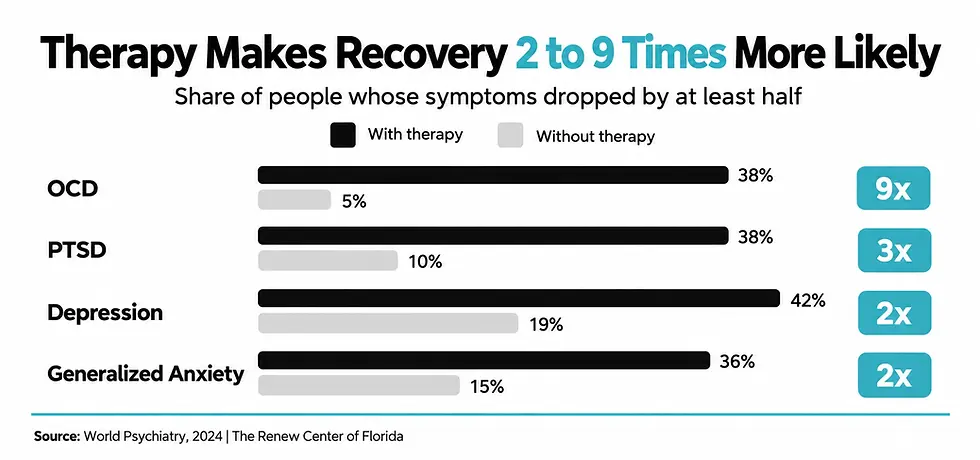
For 7 of the 8 conditions researchers studied, people in therapy were 2 to 9 times more likely to improve a lot than people without it. The figures below come from the largest recent review, which covered 441 studies and 33,881 people (Cuijpers et al., 2024). In each case, "success" means that a person's symptoms dropped by at least half by the end of the study.
Therapy for depression helped 42% of people improve a lot, compared with 19% of people without therapy, which makes success about 2 times more likely.
Therapy for PTSD and trauma helped 38% of people improve a lot, compared with just 10% without therapy, which makes success about 3 times more likely.
Therapy for OCD helped 38% of people improve a lot, compared with only 5% without therapy, which makes success about 9 times more likely and gives OCD the biggest gap of any condition.
Therapy for panic disorder helped 38% of people improve a lot, compared with 16% without therapy, which makes success about 2 times more likely.
Therapy for generalized anxiety helped 36% of people improve a lot, compared with 15% without therapy, which makes success about 2 times more likely.
Therapy for social anxiety helped 32% of people improve a lot, compared with 12% without therapy, which makes success about 3 times more likely.
Therapy for specific phobias helped 32% of people improve a lot, compared with 9% without therapy, which makes success about 3 times more likely.
Therapy for borderline personality disorder helped 24% of people improve a lot, compared with 15% without therapy, but short studies showed no clear difference because this condition usually needs longer, specialized care.
Therapy for teens with depression helped 58% of young people recover, compared with 36% of teens who went without it.
Therapy Success Rate Stats For Addiction Recovery:
Addiction treatment succeeds about as often as treatment for other long-term health conditions, and most people who once struggled with drugs or alcohol eventually reach recovery. Because addiction is a chronic condition, researchers judge its success the same way doctors judge care for asthma or high blood pressure: by how well people manage it over time, not by a one-time cure.
Addiction treatment matches other chronic care. The National Institute on Drug Abuse reports that 40% to 60% of people relapse after addiction treatment, compared with 50% to 70% of people treated for high blood pressure or asthma (NIDA). In other words, addiction treatment works at least as well as care for conditions that no one calls untreatable.
Most people reach recovery over time. In 2025, 73% of U.S. adults who had ever had a drug or alcohol problem, or 22.3 million people, considered themselves in recovery or fully recovered (SAMHSA, 2025 NSDUH).
A relapse signals a needed change, not a failure. When symptoms return, your care team adjusts the plan, just as a doctor would change an asthma or blood pressure treatment that has stopped working.
Treating mental health alongside addiction improves results. Many people who struggle with addiction also live with depression, anxiety or trauma, and they tend to do best when their care team treats both conditions at the same time.
Addiction recovery takes time and ongoing support, but the numbers show that treatment works and that lasting recovery is the most common long-term outcome.
Which Type of Therapy Works Best?
Several types of therapy work about equally well, so the best choice is usually the one built for your condition and delivered by a therapist you trust. The figures below come from the same 2024 review of 441 studies, which broke down success rates by type of therapy. As before, "success" means that a person's symptoms dropped by at least half.
Cognitive behavioral therapy (CBT) helps people change unhelpful thoughts and habits, and researchers have studied it more than any other therapy. CBT helped 44% of people with depression, 41% with panic disorder, 38% with OCD, 35% with social anxiety and 34% with generalized anxiety improve a lot.
Behavioral activation helps people rebuild healthy routines and return to activities they value. It helped 53% of people with depression improve a lot, although researchers have tested it in fewer studies than CBT.
Interpersonal therapy (IPT) focuses on relationships and major life changes, and it helped 42% of people with depression improve a lot.
Exposure and response prevention (ERP) helps people face their fears without giving in to compulsions. It helped 43% of people with OCD improve a lot, compared with only 5% of people without therapy.
Exposure therapy helps people face feared situations step by step, and it helped 35% of people with specific phobias improve a lot, compared with 9% without therapy.
Trauma-focused therapies help people process painful memories safely. Trauma-focused cognitive therapy helped 52% of people with PTSD improve a lot, trauma-focused CBT helped 35%, and trauma-focused exposure therapy helped 36%, compared with 10% of people without therapy.
EMDR (eye movement desensitization and reprocessing) helped 34% of people with PTSD improve a lot, which makes success about 4 times more likely than going without therapy.
Dialectical behavior therapy (DBT) teaches skills for managing intense emotions, and it helped 24% of people with borderline personality disorder improve a lot within the short time frame of most studies.
How Long Does Therapy Take to Work? Session-by-Session Statistics
Many people notice change within 4 to 8 weekly sessions, while bigger and longer-lasting change often takes about 5 to 8 months. A landmark study of about 2,400 patients tracked how many people felt measurably better after each stage of therapy, and a later study measured how long full recovery takes.
After 2 sessions, 30% of people already feel measurably better, which shows that simply starting therapy and feeling heard can bring early relief.
After 4 sessions, 41% of people feel measurably better as they begin to understand their patterns and try new skills.
After 8 sessions, 53% of people feel measurably better, which makes the first two months the period of fastest progress.
After 21 sessions, about half of people move fully into the healthy range, meaning their symptoms no longer hold them back in daily life.
After 26 sessions, 75% of people feel measurably better, although progress now comes at a slower, steadier pace.
After 35 sessions, about 70% of people reach the healthy range, which shows that deeper recovery often takes several months of consistent work.
In short, therapy delivers its biggest gains early and then builds lasting change over time. People who face trauma or several conditions at once often need more time or more support each week.
What Helps Therapy Work Better? Key Statistics:
Two factors show the strongest links to therapy success in the research: a strong relationship with your therapist and staying in therapy long enough for it to work.
295 studies and more than 30,000 patients show that a stronger bond between client and therapist predicts better results.
98% of the results in that review pointed in the same direction, and only 2% showed a negative link between the therapist relationship and outcomes.
Online therapy showed the same pattern: the link between the therapist relationship and success measured 0.275 online, almost identical to 0.278 for in-person therapy.
1 in 5 people (19.7%) leave therapy early, according to a review of 669 studies with 83,834 clients.
Younger clients, people with personality or eating disorders, and people who see therapists still in training leave therapy early more often than other groups, according to the same review.
53% of people feel measurably better by their 8th session, so people who leave before then often miss the stage when therapy starts to pay off.
What If Therapy Isn't Working? Non-Response Statistics
Therapy does not help everyone right away, and the research shows how often that happens, how often people get worse, and why slow progress rarely means therapy has failed.
58% to 76% of people do not reach a 50% drop in symptoms by the end of a typical research study, depending on the condition.
About 2 in 3 people with depression still have some symptoms at the end of a study, since roughly 1 in 3 reach full remission.
Only 5% of people in therapy for depression get worse, compared with 12% to 13% of people who go without therapy, so therapy cuts the risk of decline by more than half (Cuijpers et al., 2021).
47% of people have not yet felt measurably better by their 8th session, but that number drops to 25% by the 26th session, which shows that many slow starters improve with more time.
About 21 sessions pass before half of people reach the healthy range, so most research studies end before many people finish improving.
295 studies link a stronger therapist relationship to better results (Flückiger et al., 2018), which is why switching to a therapist who fits you better can restart progress.
If you still feel stuck after 6 to 8 sessions, these numbers suggest that changing the plan works better than giving up: talk openly with your therapist, check the fit, and ask about a different approach or a higher level of care.
When clients feel stuck, we help them identify the thoughts, emotions, and patterns that may be keeping them from moving forward. From there, we work on practical coping skills, healthier responses, and small steps that can lead to meaningful and lasting change - Dr Lisa Palmer LMFT, PhD, CHT, CRRTT
Therapy Myths vs. Facts:
People often repeat popular therapy statistics without their original context, so here is the truth behind four common claims.
Myth | Fact |
"Therapy cures 75% of people." | About 75% of people improve after roughly 26 sessions, but improving and fully recovering are two different things. |
"The client drives 40% of results, the relationship 30%, technique 15% and hope 15%." | Psychologist Michael Lambert offered these figures as an estimate in 1992. The general idea holds up, but no study ever measured these exact numbers. |
"Therapy cures 90% of trauma survivors in 3 sessions." | This claim comes from small early studies. Across 87 larger PTSD studies, 38% of people in therapy cut their symptoms in half, compared with 10% of people without therapy. |
"A 40% to 60% relapse rate proves addiction treatment fails." | Addiction relapse rates match those for asthma and high blood pressure, and a relapse simply tells the care team to adjust the plan. |
Treat any number without a clear source with caution, because the real research results are strong enough on their own and need no exaggeration.
Therapy Success Rate Statistics in the U.S.: How Many Americans Recover?
National survey data shows that treatment reaches millions of Americans each year, and most people who once struggled with their mental health or substance use now consider themselves in recovery.
44.1 million U.S. adults, or about 7 in 10 adults who ever had a mental health problem, considered themselves in recovery or recovered in 2025.
22.3 million U.S. adults, or 73% of adults who ever had a drug or alcohol problem, considered themselves in recovery or recovered in 2025 (SAMHSA, 2025 NSDUH).
70.8% of U.S. adults with a serious mental illness, or 10.3 million people, received mental health treatment in 2024.
57.7% of U.S. teens with major depression, or 2.1 million adolescents, received mental health treatment in 2025 (SAMHSA, 2025 NSDUH).
23.0% of U.S. adults, or 59.2 million people, received mental health treatment in 2024, while 23.4% lived with a mental health condition (SAMHSA, 2024 NSDUH).
15.3% of Americans age 12 and older had a substance use disorder in 2025, down from 16.8% in 2024.
These numbers show that recovery is the most common long-term outcome, not the exception. If you are struggling, you are far from alone, and millions of Americans who took the same step you are considering now describe themselves as recovered.
FAQs:
What percentage of people benefit from therapy?
Most people who stay in therapy benefit from it. About 53% of people feel measurably better by their 8th session, and about 75% feel better by their 26th. When researchers look for a bigger change, such as symptoms dropping by half, 32% to 42% of people with common conditions reach that goal, which is two to three times more than people who skip therapy.
What is the success rate of therapy for depression?
About 42% of adults with depression see their symptoms drop by at least half in therapy, while only about 19% see that change without it. Roughly 1 in 3 people in therapy recover fully, compared with 7% to 13% of people who go without treatment. Researchers drew these numbers from reviews of 228 studies.
Is therapy as effective as medication?
For mild to moderate depression and anxiety, therapy and medication often work about equally well in the short term. Therapy also teaches you skills that you keep using after treatment ends. For more severe depression, many people get the best results when they combine the two, so talk with both a therapist and a doctor about what fits your needs.
How many therapy sessions does it take to work?
Many people notice change within 4 to 8 sessions: about 41% feel better by session 4 and 53% by session 8. Lasting recovery usually takes longer, and half of people need around 21 sessions to reach the healthy range. People who deal with trauma or several conditions at once may need more time or a more intensive program.
Which type of therapy has the highest success rate?
No single therapy works best for everyone. For depression, behavioral activation (53%), CBT (44%) and interpersonal therapy (42%) all perform well. For OCD, exposure and response prevention helped 43% of people, and for PTSD, trauma-focused therapies helped between 35% and 52%. The best choice is usually the therapy built for your condition, delivered by a therapist you trust.
Does therapy work for teenagers?
Yes, therapy works well for teenagers. In studies of teen depression, 58% of teens in therapy recovered, compared with 36% of teens who went without it. Teens often make the most progress when their family takes part in treatment in a way that respects the teen's privacy and personal goals.
Is online therapy as effective as in-person therapy?
Online therapy works well for many people. Research across 295 studies shows that a strong relationship with your therapist predicts success just as reliably online as it does in person. People who need more intensive support, or who find it hard to open up on a screen, may still prefer to meet face to face.
Can therapy make things worse?
Therapy can feel difficult at times, and a small number of people do get worse, but therapy actually lowers that risk overall. In depression studies, 5% of people in therapy got worse, compared with 12% to 13% of people without therapy. If you keep feeling worse, tell your therapist so that you can change the plan together.
Why do people quit therapy early?
About 1 in 5 people quit therapy early, and they usually leave because they don't click with their therapist, struggle with cost or scheduling, or start feeling better quickly. Younger people quit early more often than older adults. When you talk openly with your therapist about your doubts, you can often solve the problem without leaving.
How do I know if my therapy is working?
You will usually notice small changes first, such as sleeping better, reacting more calmly, or using a skill from therapy in your daily life. Most people notice some change within 8 sessions. Ask your therapist to track your symptoms every few weeks, and if nothing has changed by session 6 to 8, review the plan together.
Sources:
Howard, K. I., et al. (1986). The dose-effect relationship in psychotherapy. American Psychologist.
SAMHSA National Survey on Drug Use and Health: 2024 results and 2025 results.


