
Best Anorexia Treatment Centers in Florida: Residential, Outpatient and Virtual Options

Searching for eating disorder treatment usually starts with one hard question: does anorexia need a residential stay, or can care happen while life at home continues? The answer shapes the cost, the time away from school or work, and how soon treatment can begin. Florida has options at every level of care, but they are spread across the state and described in very different ways, which makes them hard to compare when you need answers quickly.
This guide ranks the 10 best anorexia treatment centers in Florida and groups them by type of care: hospital, residential, day treatment, outpatient and virtual. It is written for adults with anorexia nervosa and for parents of teens who are comparing option.

If you or someone you love is in medical danger, call 911 or go to the nearest emergency room. For support, the ANAD Helpline is available at 1-888-375-7767.
Key takeaways
Florida offers every level of anorexia care, from hospital stabilization in Miami to residential programs in Coconut Creek, South Miami, Montverde and Jacksonville.
Medical stability decides where treatment should start. A physician should make that call.
Outpatient and virtual programs let medically stable teens and adults stay at home, school and work during treatment.
Cost depends mostly on level of care, length of stay and insurance network status.
Florida Anorexia Treatment Centers at a Glance:
The table below lists every center in this guide with its type of care, ages served and location. Use it to narrow your list before reading the full entries. Ages and services can change, so confirm details with each center before you enroll.
Rank | Center | Type of care | Ages | Location | Virtual option |
1 | The Renfrew Center of Florida | Residential, day treatment, IOP, outpatient | Teens and adults | Coconut Creek, Orlando, West Palm Beach | Yes |
2 | Intensive outpatient, outpatient | Teens and adults | Boca Raton | Yes, statewide | |
3 | Monte Nido Miami | Residential, day treatment | Adults (residential); adults and teens (day) | South Miami | Separate virtual programs |
4 | Center for Discovery Montverde | Residential, PHP | 9 to 17 | Montverde | Yes |
5 | Center for Discovery Maitland and Tampa | PHP, IOP | 10 and up | Maitland, Tampa | Yes |
6 | Monte Nido Clementine South Miami | Residential | Girls 11 to 17 | Miami | Separate virtual programs |
7 | Koru Spring | Residential | Contact center | Jacksonville | Contact center |
8 | Milestones in Recovery | Residential, day treatment, IOP, outpatient | Adults | Hollywood | No |
9 | Nicklaus Children's Hospital Eating Disorders Program | Hospital inpatient stabilization, outpatient | Children and teens | Miami | Contact center |
10 | Equip | Virtual family-based treatment | Contact center | Virtual | Yes (virtual only) |
How We Ranked These Centers:
Ranking treatment programs is not simple, because the right program depends on each person's medical needs. We used five criteria and applied them the same way to every center, including our own.
Ranking Criteria
Eating disorder specialization: the program treats eating disorders, including anorexia nervosa, as a core service.
Levels of care in Florida: the range of care the program offers in the state, and how clearly it describes them.
Clinician-led care: visible clinical leadership and published credentials.
Access across Florida: in-person locations plus virtual reach for Florida residents.
Cost and time transparency: how clearly the program describes payment options and program length.
We did not rank centers on reported success rates. Programs measure outcomes in different ways, and most do not publish them.
The 10 Best Anorexia Treatment Centers in Florida:
Each entry below uses the same format: who the program is best for, key facts, a short description and one limitation to consider.
1. The Renfrew Center of Florida (Coconut Creek, Orlando, West Palm Beach):
Best for: the widest range of care levels in Florida from a single eating disorder provider.
Type of care: Residential, day treatment, intensive outpatient (IOP), outpatient
Ages: Adolescent and adult programs listed; confirm ages by location
Location: Coconut Creek (residential), Orlando and West Palm Beach (outpatient)
Virtual: Yes, virtual day treatment, IOP and outpatient groups
Payment: Contact center for insurance details
The Renfrew Center runs a residential program with day treatment on the same campus as a step-down option. The Coconut Creek site lists adolescent and college programs, along with educational support for middle and high school students. Its West Palm Beach location offers day treatment, IOP and outpatient services, currently delivered through virtual programming. Renfrew also lists an outpatient site in Orlando.
Consider: The Coconut Creek residential program is about 45 minutes from West Palm Beach and farther from Central and North Florida.
2. The Renew Center of Florida (Boca Raton and Virtual Statewide)
Best for: medically stable teens and adults who want clinician-led outpatient care while they stay at home, school and work.
Type of care: Intensive outpatient (IOP) eating disorder program, in 30, 60 and 90 day programs
Ages: Teens and adults
Location: 299 Camino Gardens Blvd., Suite 100, Boca Raton, FL 33432
Virtual: Yes, for clients anywhere in Florida
Payment: Private pay (cash and credit card); insurance not accepted; superbills provided
The Renew Center of Florida provides in-person outpatient anorexia treatment in Boca Raton for South Florida communities, and virtual eating disorder therapy in Florida for clients in other parts of the state. Treatment is led by Dr. Lisa Palmer, eating disorder therapist, LMFT, PhD, CHT, CRRTT, an AAMFT Approved Supervisor who has over 20 years of clinical experience working with adults and teens with eating disorders.
Programs are reality-based. That means treatment is built around the client's real daily life, including meals, school, work and family, rather than a separate residential setting. Each program has a defined length of 30, 60 or 90 days, so clients and families know the time commitment from the start. Anorexia care at Renew is delivered through its Wise Eating Disorder Program in Florida, an eating disorder program delivered in an outpatient format as an intensive outpatient program (IOP).
Why #2: Renew meets our criteria for clinician-led care, statewide access through virtual sessions and clear program length. Because it is private pay with no room and board, outpatient care at Renew typically costs less overall than residential treatment.
Consider: Renew is an outpatient program. People who are medically unstable or need daily meal support should start at a higher level of care, such as residential or hospital treatment, and can step down to outpatient care later. Renew does not accept insurance, but provides superbills that clients can submit for possible out-of-network reimbursement.
3. Monte Nido Miami (South Miami):
Best for: adults in South Florida who need residential care.
Type of care: Residential (adults); day treatment (adults and adolescents)
Ages: Adults of all genders (residential); adults and adolescents (day treatment)
Location: South Miami
Virtual: Monte Nido runs separate virtual programs
Payment: Contact center for insurance details
Monte Nido Miami offers residential eating disorder treatment for adults of all genders in South Miami. A separate day treatment program in South Miami serves both adults and adolescents, which gives patients a step-down option close to home after residential care. Monte Nido also operates virtual programs, including virtual family-based treatment for adolescents.
Consider: The residential program is for adults only. Teens needing residential care in Miami would look at Clementine South Miami.
4. Center for Discovery Montverde
Best for: adolescents in Central Florida who need residential care.
Type of care: Residential and partial hospitalization (PHP)
Ages: 9 to 17, all genders
Location: 14915 Fosgate Road, Montverde, FL 34756 (about 40 minutes west of Orlando)
Virtual: Yes, virtual programming listed
Payment: Contact center for insurance details
Center for Discovery Montverde provides residential treatment and partial hospitalization for adolescents ages 9 to 17. The program is gender-inclusive and treats teens regardless of gender identity or sexual orientation. Having residential and PHP on one site allows a teen to step down without changing treatment teams.
Consider: Montverde serves adolescents only. Adults in Central Florida would look at outpatient options such as Center for Discovery Maitland or Renfrew Orlando.
5. Center for Discovery Maitland and Tampa
Best for: step-down care in Central Florida and Tampa Bay.
Type of care: Partial hospitalization (PHP) and intensive outpatient (IOP)
Ages: 10 and up, all genders
Location: Maitland and Tampa
Virtual: Yes, outpatient programs available through telehealth
Payment: Contact center for insurance details
Center for Discovery runs PHP and IOP programs in Maitland and Tampa for patients ages 10 and up. These programs suit patients stepping down from residential care or those who need more structure than weekly therapy. Online programming is also available through telehealth.
Consider: Neither location offers residential care. The nearest Center for Discovery residential program is in Montverde.
6. Monte Nido Clementine South Miami
Best for: teen girls who need residential care in South Florida.
Type of care: Residential
Ages: Adolescent females, 11 to 17
Location: Miami
Virtual: Monte Nido runs separate virtual programs
Payment: Contact center for insurance details
Clementine South Miami is a residential eating disorder program for adolescent girls ages 11 to 17. It is part of the Monte Nido family of programs, which also includes adult residential and day treatment in South Miami. Families in South Florida can use it to keep a teen close to home during residential care.
Consider: The program serves adolescent girls only. Teen boys and nonbinary teens would look at Center for Discovery Montverde.
7. Koru Spring (Jacksonville)
Best for: residential eating disorder care in North Florida.
Type of care: Residential
Ages: Contact center to confirm
Location: Jacksonville
Virtual: Contact center to confirm
Payment: Contact center to confirm
Koru Spring is a residential eating disorder treatment center in Jacksonville, operated by Bradford Health Services. It is one of the few residential options in North Florida. For families in Jacksonville, Tallahassee and nearby areas, it can reduce travel compared with South or Central Florida programs.
Consider: Koru Spring publishes less detail about ages and levels of care than other centers on this list. Call admissions to confirm fit.
8. Milestones in Recovery (Hollywood)
Best for: adults who want residential care with step-down options at one location.
Type of care: Residential (primary), day treatment, IOP, outpatient
Ages: Adults, co-ed; contact center to confirm age range
Location: 2525 Embassy Dr., Suite 10, Hollywood, FL 33026
Virtual: Not listed
Payment: Contact center for insurance details
Milestones in Recovery is a co-ed program in Hollywood that treats anorexia, bulimia and compulsive overeating. Residential care is its main level of care, with day treatment, IOP and outpatient services also listed. A typical program length of 30 days is listed.
Consider: Virtual care is not listed, so this option suits people who can attend in person in Broward County.
9. Nicklaus Children's Hospital Eating Disorders Program (Miami)
Best for: children and teens who are medically unstable.
Type of care: Hospital inpatient medical stabilization, then outpatient care
Ages: Children and teens
Location: Miami
Virtual: Contact center to confirm
Payment: Contact hospital for insurance details
Nicklaus Children's Hospital provides inpatient stabilization for children and teens with eating disorders. Stabilization addresses medical needs first and is often the first step in treatment. After stabilization, patients are referred to ongoing outpatient care or to a higher level of care when needed.
Consider: This is a hospital program for medical stabilization, not a long-term residential program. Most patients move to another level of care afterward.
10. Equip (Virtual)
Best for: families who want home-based family-based treatment (FBT) for a young person.
Type of care: Virtual treatment adapted from family-based treatment
Ages: Contact Equip to confirm age range
Location: Virtual
Virtual: Yes, virtual only
Payment: In-network with many insurance plans; Florida Blue is listed
Equip provides virtual eating disorder treatment adapted from family-based treatment, which involves parents directly in meal support at home. A multidisciplinary care team works with the patient and family. Equip lists anorexia nervosa among the conditions it treats.
Consider: Equip is virtual only, so it does not provide in-person or medical stabilization care.
Anorexia Treatment Centers by Type of Care:
Anorexia treatment is organized into levels of care. Each level offers a different amount of medical monitoring, meal support and time in treatment. The ranked centers are grouped below by the levels they offer, with their rank in brackets.
Hospital Inpatient Care:
Hospital inpatient care provides 24-hour medical monitoring to stabilize heart rate, blood pressure, electrolytes and weight. It is used when anorexia has caused medical danger. Stays are usually short, followed by a step down to residential or day treatment.
Nicklaus Children's Hospital Eating Disorders Program, Miami
Residential Treatment Centers:
Residential treatment provides 24-hour care in a non-hospital setting, with supervised meals, daily therapy and nutrition support. It suits people who are medically stable but cannot yet eat consistently or stay safe at home.
The Renfrew Center, Coconut Creek
Monte Nido Miami (adults)
Center for Discovery Montverde (ages 9 to 17)
Monte Nido Clementine South Miami (girls 11 to 17)
Koru Spring, Jacksonville
Milestones in Recovery, Hollywood
Partial Hospitalization (PHP) and Day Treatment:
PHP and day treatment provide structured care for most of the day, often including two or more supervised meals, while patients sleep at home. It is a common step down from residential care.
The Renfrew Center (Coconut Creek day treatment; virtual day treatment)
Monte Nido Miami Day Treatment
Center for Discovery Montverde
Center for Discovery Maitland and Tampa
Milestones in Recovery
Intensive Outpatient and Outpatient Programs:
Intensive outpatient programs (IOP) meet several times a week for a few hours at a time. Outpatient care includes individual therapy, family sessions and nutrition counseling on a weekly schedule. Both suit people who are medically stable and can complete most meals with support.
The Renfrew Center (West Palm Beach, Orlando) [#1]
The Renew Center of Florida, Boca Raton [#2]
Center for Discovery Maitland and Tampa [#5]
Milestones in Recovery [#8]
Virtual Anorexia Treatment in Florida:
Virtual treatment delivers therapy, groups and sometimes meal support by secure video. It widens access for people far from a treatment center, but it does not replace in-person medical monitoring.
The Renfrew Center virtual programs
The Renew Center of Florida, statewide for Florida residents
Monte Nido virtual programs, including family-based treatment for ages 10 to 18
Center for Discovery telehealth programs
Equip
Which Level of Care Fits? A Practical Checklist:
The right level of care depends first on medical stability, which only a physician can assess. The American Psychiatric Association Practice Guideline for the Treatment of Patients With Eating Disorders (2023) describes the medical and behavioral factors clinicians use to decide where treatment should start. The checklists below summarize common signs.
Signs a Higher Level of Care Is Needed First:
Slow, irregular or unstable heart rate or blood pressure
Abnormal lab results, such as low potassium or other electrolyte problems
Fainting, dizziness when standing, or chest pain
Rapid or ongoing weight loss despite outpatient care
Inability to eat without daily, supervised meal support
Thoughts of suicide or self-harm (call or text 988 right away)
If any of these apply, ask a physician about hospital, residential or PHP care.
When Outpatient Treatment Can Be a Good Fit
A physician has confirmed medical stability
The person can complete most meals with support at home
The person is willing to take part in therapy and nutrition counseling
There is a support person at home (for teens, parents involved in care)
The person is stepping down from residential care or PHP
If you are unsure, start with a medical evaluation. Many people move between levels of care during recovery, and stepping up or down is a normal part of treatment.
What Each Level of Care Asks of Your Daily Life:
Choosing a level of care also means choosing how treatment fits around home, school and work. Hours vary by program, so use these ranges as a starting point for questions.
Level of care | Typical time in treatment | Live at home? | Typical school or work impact |
Hospital inpatient | 24 hours a day | No | Full leave |
Residential | 24 hours a day | No | Full leave; some programs offer schooling |
PHP / day treatment | About 6 to 8 hours a day, 5 or more days a week | Yes | Usually a leave or reduced schedule |
Intensive outpatient (IOP) | About 3 hours a day, 3 to 5 days a week | Yes | Often scheduled around school or work |
Outpatient | About 1 to 3 hours a week | Yes | Little disruption |
Virtual (IOP or outpatient) | Same as in-person equivalent | Yes | Little disruption; no travel time |
Cost of Anorexia Treatment in Florida:
The cost of anorexia treatment varies widely, so programs rarely publish fixed prices. Five factors drive most of the cost:
Level of care: 24-hour care costs more than day or outpatient care.
Length of stay: longer programs cost more in total.
Room and board: residential programs include housing and meals; outpatient programs do not.
Medical monitoring: hospital care and on-site physicians add cost.
Insurance network status: in-network care usually means lower out-of-pocket costs.
Insurance Coverage
Many residential, PHP and IOP programs work with commercial insurance. Coverage depends on your plan and on medical necessity, which is usually reviewed by the insurer before and during treatment. The federal Mental Health Parity and Addiction Equity Act of 2008 generally requires plans that cover mental health care to cover it on terms comparable to medical care. Call your insurer and ask about eating disorder benefits, which levels of care are covered, and whether prior authorization is required.
Private Pay and Out-of-Network Options
Private-pay programs set their own fees and do not require insurance approval for each phase of care. Outpatient private-pay programs avoid room-and-board costs and have a defined length, which makes the total cost easier to plan. If you have out-of-network benefits, ask the program for a superbill you can submit to your insurer for possible partial reimbursement. The Renew Center of Florida is a private-pay program that accepts cash and credit cards and provides superbills on request.
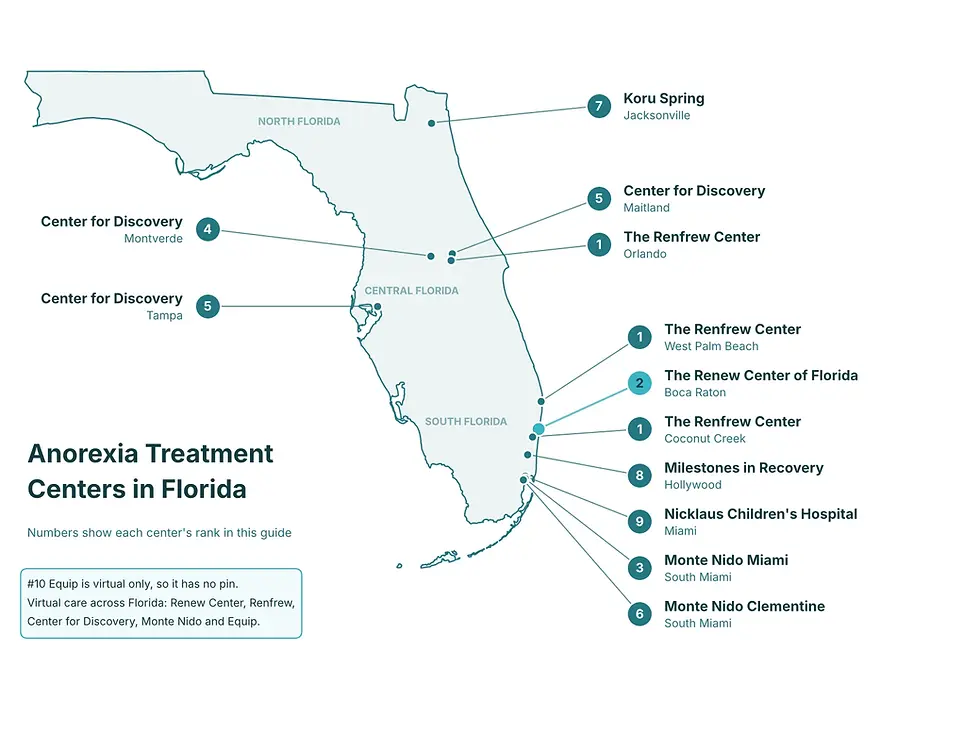
Anorexia Treatment Centers by Florida Region:
Distance matters, especially for families who plan to take part in treatment. Here is where each ranked program is located.
South Florida (Miami-Dade, Broward, Palm Beach)
The Renfrew Center, Coconut Creek (residential, day) and West Palm Beach (virtual day, IOP, outpatient)
The Renew Center of Florida, Boca Raton (IOP, outpatient)
Milestones in Recovery, Hollywood (residential, day, IOP, outpatient)
Monte Nido Miami, South Miami (adult residential, day)
Monte Nido Clementine South Miami, Miami (adolescent girls residential)
Nicklaus Children's Hospital, Miami (hospital stabilization)
Central Florida and Tampa Bay
The Renfrew Center, Orlando (outpatient)
Center for Discovery, Montverde (adolescent residential, PHP)
Center for Discovery, Maitland (PHP, IOP)
Center for Discovery, Tampa (PHP, IOP)
North Florida
Koru Spring, Jacksonville (residential)
Virtual programs below are the main option for many North Florida families who need IOP or outpatient care close to home.
Statewide Virtual Options
The Renew Center of Florida (all Florida residents)
The Renfrew Center virtual programs
Center for Discovery telehealth programs
Monte Nido virtual programs
Equip
Questions to Ask Before You Choose a Center:
A short admissions call can tell you whether a program fits. Ask these eight questions:
Do you specialize in eating disorders, including anorexia? General mental health programs may not offer meal support or nutrition care.
Which levels of care do you offer, and how do step-up and step-down work? Continuity matters if needs change.
Who leads treatment, and what are their credentials? Look for licensed clinicians with eating disorder experience.
Are a physician and a registered dietitian involved? Anorexia care usually needs medical and nutrition support alongside therapy.
How are families involved, especially for teens? Family involvement is a core part of many adolescent treatment models.
How long is the program? A defined length helps with school, work and budget planning.
What does it cost, and which payment options apply? Ask about insurance, private pay and superbills.
What happens after discharge? Ask about aftercare, alumni support and referrals.
Talk With Dr. Lisa Palmer About Outpatient Anorexia Treatment:
If you or your teen is medically stable and looking for outpatient care, The Renew Center of Florida offers 30, 60 and 90 day programs in Boca Raton and virtually across Florida. Your first step is an Initial Discovery Call with Dr. Lisa Palmer, LMFT, PhD, CHT, CRRTT, to talk about your needs and whether outpatient care is the right fit. If a higher level of care is needed first, Dr. Palmer can help you find an appropriate referral.
Frequently Asked Questions:
Do I need residential treatment for anorexia, or can outpatient care work?
It depends on medical stability, which a physician should assess. People with unstable vital signs, abnormal labs, rapid weight loss or an inability to eat without daily support usually need hospital or residential care first. People who are medically stable, can complete most meals with support and have help at home may do well in IOP or outpatient care. Many people start at a higher level and step down to outpatient treatment over time.
What is the difference between PHP and IOP for anorexia treatment?
The main difference is the number of hours in treatment each week. Partial hospitalization (PHP) usually runs most of the day, five or more days a week, and often includes supervised meals. Intensive outpatient (IOP) typically meets about three hours a day, three to five days a week. PHP offers more structure and meal support, while IOP leaves more time for school, work and home life.
How long does anorexia treatment usually last?
Anorexia treatment usually lasts several months across all levels of care, though the length varies by person. Residential stays are often measured in weeks, while outpatient care may continue for months to support recovery at home. Some outpatient programs, such as The Renew Center of Florida, use defined 30, 60 or 90 day programs. Ask each center how it decides when a patient is ready to step down.
Is anorexia treatment different for teens than for adults?
Yes, treatment for teens usually involves the family much more directly. Family-based treatment (FBT), where parents take an active role in meal support, is widely used for adolescents. Teen programs also coordinate with schools and often include educational support. Adult programs focus more on individual therapy, independence with meals, and balancing treatment with work and relationships. Several Florida centers serve only teens or only adults, so check age ranges first.
Can I get anorexia treatment in Florida virtually?
Yes, several programs offer virtual anorexia treatment to Florida residents. The Renew Center of Florida, The Renfrew Center, Center for Discovery, Monte Nido and Equip all list virtual or telehealth options. Virtual care works best for people who are medically stable, because it cannot provide in-person monitoring. Ask how the program handles medical check-ins, such as weight and vital signs, with a local physician.
Does insurance cover anorexia treatment in Florida?
Many insurance plans cover anorexia treatment, but coverage depends on your plan and medical necessity. The Mental Health Parity and Addiction Equity Act of 2008 generally requires comparable coverage for mental health and medical care in plans that include both. Call your insurer to ask which levels of care are covered and whether prior authorization is needed. Private-pay programs may provide a superbill for out-of-network reimbursement.
What role does a dietitian play in anorexia treatment?
A registered dietitian helps restore regular eating and nutrition safely. Dietitians create meal plans, help patients challenge feared foods, and track progress with the treatment team. During early refeeding, they work with physicians to monitor for medical complications. In outpatient care, they often meet with patients weekly and may also support parents who are managing meals for a teen at home.
Can anorexia treatment also address anxiety or depression?
Yes, most eating disorder programs treat co-occurring anxiety, depression and trauma alongside anorexia. These conditions often appear together and can affect recovery if left untreated. Ask each program how it handles co-occurring conditions, whether a psychiatrist is available for medication management, and how individual therapy is structured. Treating the whole picture usually gives patients more stable footing in recovery.
How do I know if an anorexia treatment center is licensed in Florida?
You can check facility licenses through the Florida Agency for Health Care Administration on FloridaHealthFinder.gov. Individual clinicians, such as therapists, physicians and dietitians, can be verified through the Florida Department of Health license lookup at flhealthsource.gov. Also ask whether the program holds national accreditation, such as from The Joint Commission, and which licensed professionals lead each part of care.


